
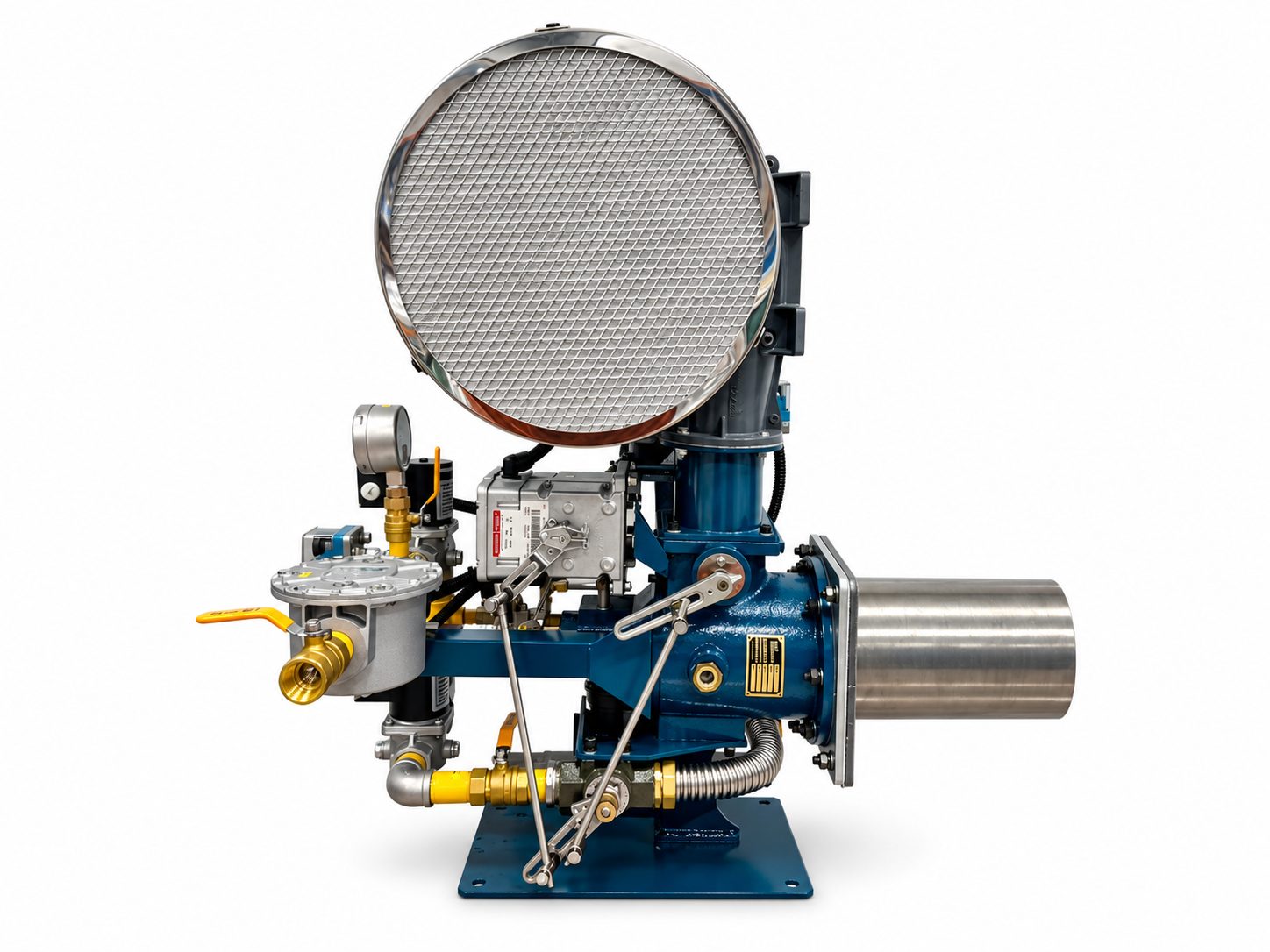
Every industrial gas burner does the same three jobs: it delivers gas and air in the right proportion, mixes them so they burn completely, and proves that a stable flame is there before and while fuel flows. The differences between burner types are in how each job is done.
Gas burns only when it is mixed with enough air and lit. Natural gas needs roughly 9.5 to 10 volumes of air for every volume of gas to burn completely (the stoichiometric ratio); propane needs about 24. Industrial burners run with some excess air above that, commonly 10 to 30 % at high fire, so that every gas molecule finds oxygen even where mixing is not perfect. Too little air leaves carbon monoxide and soot; too much wastes heat by warming air that does no work. Residual oxygen in the flue gas is the usual way to check where a burner sits: around 3 % O2 corresponds to about 15 % excess air.
Combustion air comes from a fan. On a packaged burner such as the SBJ Series the fan is built onto the burner; on larger systems one fan feeds several burners through a header. An air pressure switch proves the fan is running before anything else is allowed to happen, and a damper or valve, driven by an actuator, sets how much air goes through. On a line or duct burner the process air stream itself supplies most of the combustion air, so the air velocity across the burner has to stay within the range the burner was designed for.
Gas reaches the burner through a gas train: isolation valve, filter, pressure regulator, low and high gas pressure switches, two automatic safety shut-off valves in series and a flow-control valve. The safety valves are the part that actually stops the fuel when the control says so; they close by spring force when power is removed. Each part is described in gas train components explained, and how the valves are checked for leaks in valve proving and leak testing.
| Type | Where mixing happens | Strengths | Limits |
|---|---|---|---|
| Premix | Gas and air are mixed upstream, in a mixer or the fan inlet, and the mixture flows to the burner head | Short, compact flame; simple ratio control | Narrower turndown; the mixture in the pipework is combustible, so flashback has to be designed out |
| Nozzle-mix | Gas and air travel separately and meet only at the burner nozzle | Wide turndown; can run with high excess air for a cooler flame; no combustible mixture in the pipes | Needs a fan and a good ratio control system |
| Line / duct (raw gas) | Gas is released along a manifold between mixing plates; the passing air stream provides the combustion air | Spreads heat evenly across a duct or oven; very wide turndown; high efficiency because no extra air is heated | Works only within a set air velocity and oxygen content of the stream |
| Atmospheric (inspirating) | The gas jet draws in air through an opening by its own momentum | No fan, few parts | Small outputs and limited control; rarely used on process plant |
High-velocity burners, such as the STJ Series, are nozzle-mix burners with a combustion tube that accelerates the hot gas, so the flame stirs the furnace atmosphere. Line and duct burners are used in drying ovens and air heaters where the heat has to be spread across a wide air stream.
A burner control (flame safeguard) runs the same steps every time the burner starts. The exact times depend on the standard applied (for example EN 746-2 or NFPA 86) and the burner rating, but the order is the same:
If something trips during the run, such as gas pressure dropping or the flame going out, the control closes the valves at once. The fault codes each control shows are explained in our guides to Honeywell 7800 fault codes and Siemens LME blink codes, and the usual causes of a failed start in gas burner won't light.
A burner may only pass gas while a flame is proven. Two detectors cover most gas burners. A flame rod uses the flame as a conductor: the control applies an AC voltage to a rod in the flame and looks for the small rectified DC current that only a real flame produces. A UV scanner looks at the flame through a sight tube and responds to the ultraviolet radiation of the combustion zone. Flame rods suit small burners and pilots where the rod can sit in the flame; UV scanners suit larger burners and oil, where a rod would not survive. See UV scanner vs flame rod.
As the burner moves from low to high fire, gas and air flow must change together. There are three common ways to do it:
How to set and check the ratio with a flue gas analyser is in air-fuel ratio tuning.
Most process burners spend little time at full fire. Turndown is the ratio of maximum to minimum stable firing rate; a burner with 10:1 can hold a stable flame at a tenth of its rating. Wide turndown lets the burner follow the load instead of switching on and off, which saves purge losses and keeps temperature steady. See burner turndown ratio explained.
Send us the process, the temperature, the air flow or furnace size and the fuel on site, and we will propose a burner, gas train and control panel.
A fan supplies combustion air, a gas train supplies gas at a controlled pressure, and the burner head mixes the two so they burn completely. A burner control purges the chamber, ignites the burner and keeps the gas valves open only while a flame detector proves the flame.
In a premix burner gas and air are mixed before they reach the burner head. In a nozzle-mix burner they travel separately and meet only at the nozzle, which gives wider turndown and allows high excess air, with no combustible mixture in the pipework.
About 9.5 to 10 volumes of air per volume of natural gas for complete combustion. Industrial burners usually run 10 to 30 % above that at high fire.
A nameplate photo, or your heat load, fuel and gas pressure. The reply comes from an engineer.
WhatsApp an engineer → [email protected]