
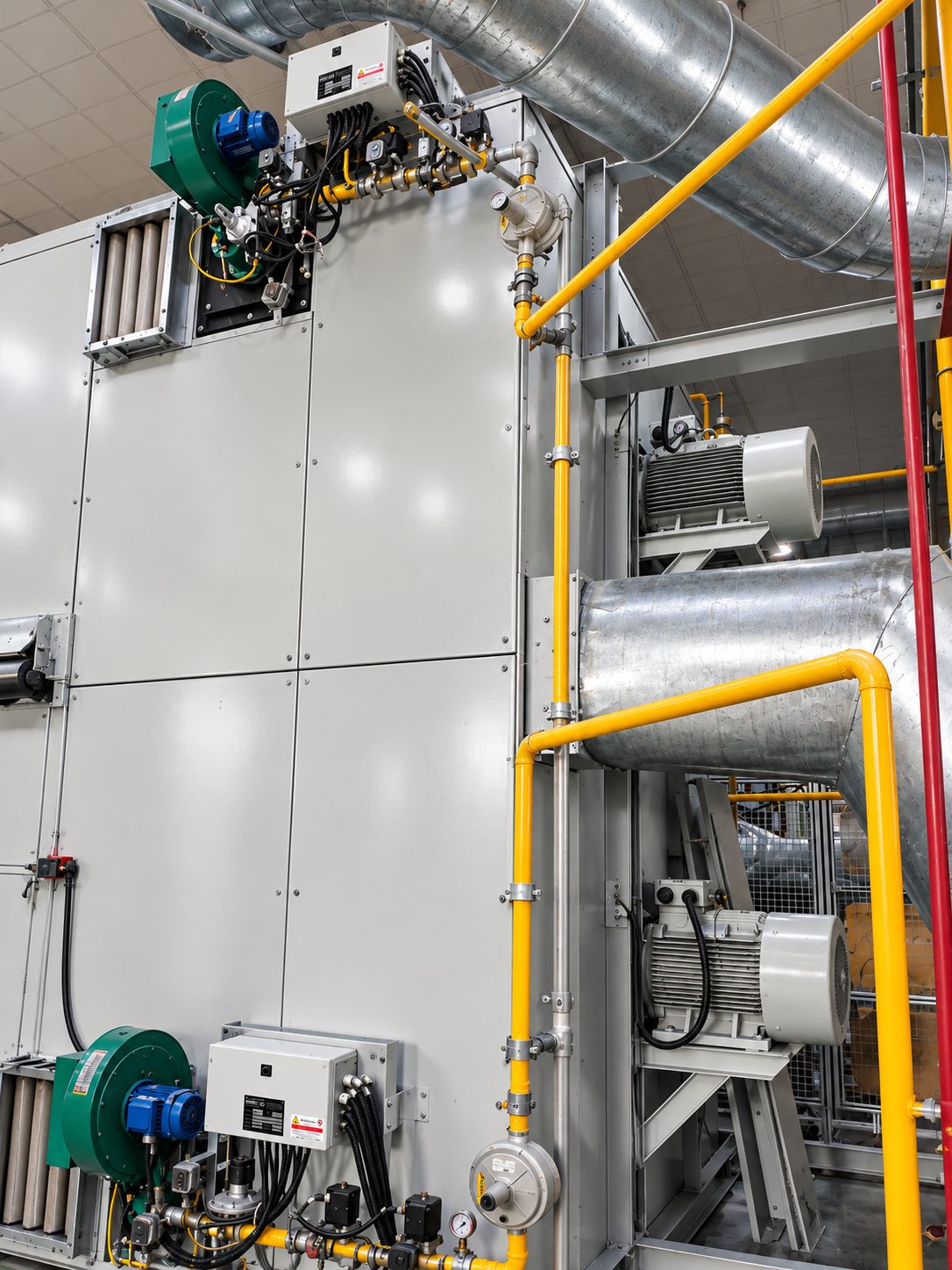
A gas burner burns cleanly and economically only inside a narrow band of air-fuel ratio. Too little air and it makes CO and soot. Too much and it heats air it then throws up the stack. A flue gas analyser and a clear idea of what to adjust are enough to keep most burners in that band.
Safety first. Combustion tuning is done with the burner firing, so it belongs to a qualified burner technician with a calibrated analyser. Never run a burner rich to "see what happens", and stop at once if CO climbs fast.
Natural gas needs about 9.5 to 10 m³ of air per m³ of gas to burn completely (stoichiometric). Real burners run with some extra air so that every molecule of gas finds oxygen. That extra air shows up in the flue gas as O2:
| O2 in dry flue gas | Excess air (approx.) | What it usually means |
|---|---|---|
| Below 1 % | Under 5 % | Close to rich; CO risk, especially if air or gas pressure drifts |
| 2 to 4 % | 10 to 25 % | Typical target for packaged gas burners at high fire |
| 4 to 6 % | 25 to 40 % | Common at low fire, where mixing is weaker |
| Above 8 % | Over 60 % | Wasting fuel, unless the process needs excess air (many direct-fired dryers and ovens do) |
CO is the check on the low side. A well-tuned gas burner usually shows CO well under 100 ppm; a sudden rise as you reduce air marks the edge, and the setting should stay safely on the lean side of it. Local emission limits and the burner manual come first.
Direct-fired air heaters are different. Line and duct burners firing into a large air stream run at very high overall excess air by design. There the check is CO and NO2 in the heated air and the flame shape, not stack O2.
Related: turndown ratio explained and gas burner won't light.
Need a burner re-tuned or a ratio part replaced? Send the burner nameplate, the control system and your last flue gas readings on WhatsApp. Every SENNISI burner leaves our workshop with its combustion readings recorded on the commissioning sheet.
Siemens, Azbil, Kromschröder, Eclipse and Dungs are trademarks of their owners. SENNISI is an independent company and is not affiliated with these manufacturers.
A nameplate photo, or your heat load, fuel and gas pressure. The reply comes from an engineer.
WhatsApp an engineer → [email protected]