
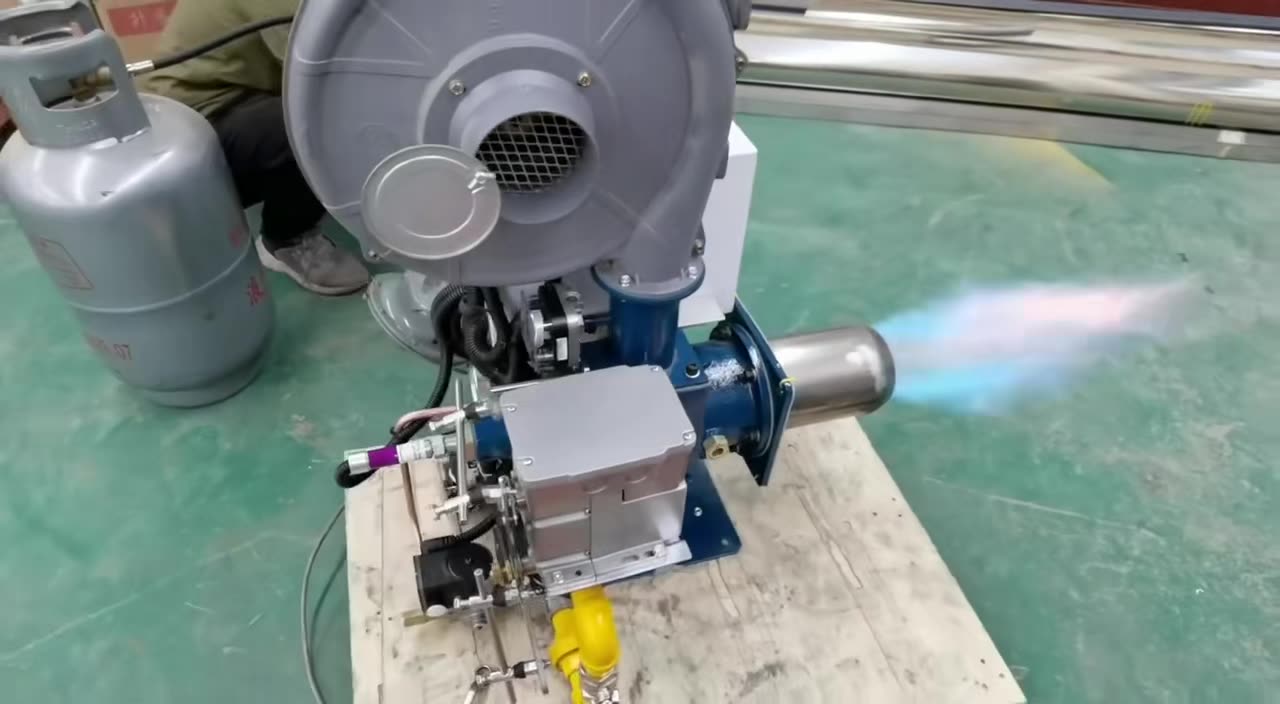
Every burner safeguard needs proof that the flame is there. On industrial burners that proof comes from either a flame rod in the flame or a UV scanner looking at it. Both work well when they fit the burner. Most nuisance flame failures come from the wrong choice or a small installation detail, not from a bad control.
Safety first. Flame detection is the last line of protection against unburnt gas in a furnace. Never bridge a flame signal or swap in a detector type the control was not built for. Work on flame safeguards belongs to a qualified burner technician.
A flame rod (ionization electrode) sits in the flame. The control puts an AC voltage between the rod and the burner body. A flame conducts a small current, and because the burner body is much larger than the rod, it conducts better in one direction. The control looks for that rectified DC current, typically a few microamps. A short circuit to earth gives AC, not DC, so it is not mistaken for a flame.
A UV scanner sees the ultraviolet light a gas or oil flame gives off, in a narrow band that hot refractory and daylight through a sight glass do not reach. Honeywell C7027, C7035 and C7044, Siemens QRA and Kromschröder UVS are common examples. It sits outside the flame, behind a sight tube.
| Flame rod (ionization) | UV scanner | |
|---|---|---|
| Fuel | Gas only | Gas and oil |
| Typical burners | Packaged gas burners, line and duct burners, pilots | Large burners, oil and dual-fuel, burners where a rod would burn away |
| Main weak points | Rod out of the flame, cracked ceramic, poor earth | Dirty lens or sight glass, seeing the ignition spark, oil mist and smoke |
| Continuous operation | Fine with a suitable control | Standard tubes can fail into a false flame signal: use a self-check scanner, or let the burner restart at least once a day |
A UV tube can age into a state where it reports flame when there is none. On a burner that cycles, the control catches this at the next start. On a furnace that runs for days, it cannot. Self-check scanners such as the Honeywell C7061 or Siemens QRA with shutter test themselves many times a minute. If the burner runs more than 24 hours without stopping, use one, matched to an amplifier or control that supports it.
Lockout codes: see Honeywell 7800 fault codes and Siemens LME blink codes.
Not sure which detector your burner needs? Send a photo of the burner and the control label on WhatsApp. We tell you the original part, or a compatible replacement, before you order.
Honeywell, Siemens and Kromschröder are trademarks of their owners. SENNISI is an independent company and is not affiliated with these manufacturers.
A nameplate photo, or your heat load, fuel and gas pressure. The reply comes from an engineer.
WhatsApp an engineer → [email protected]