
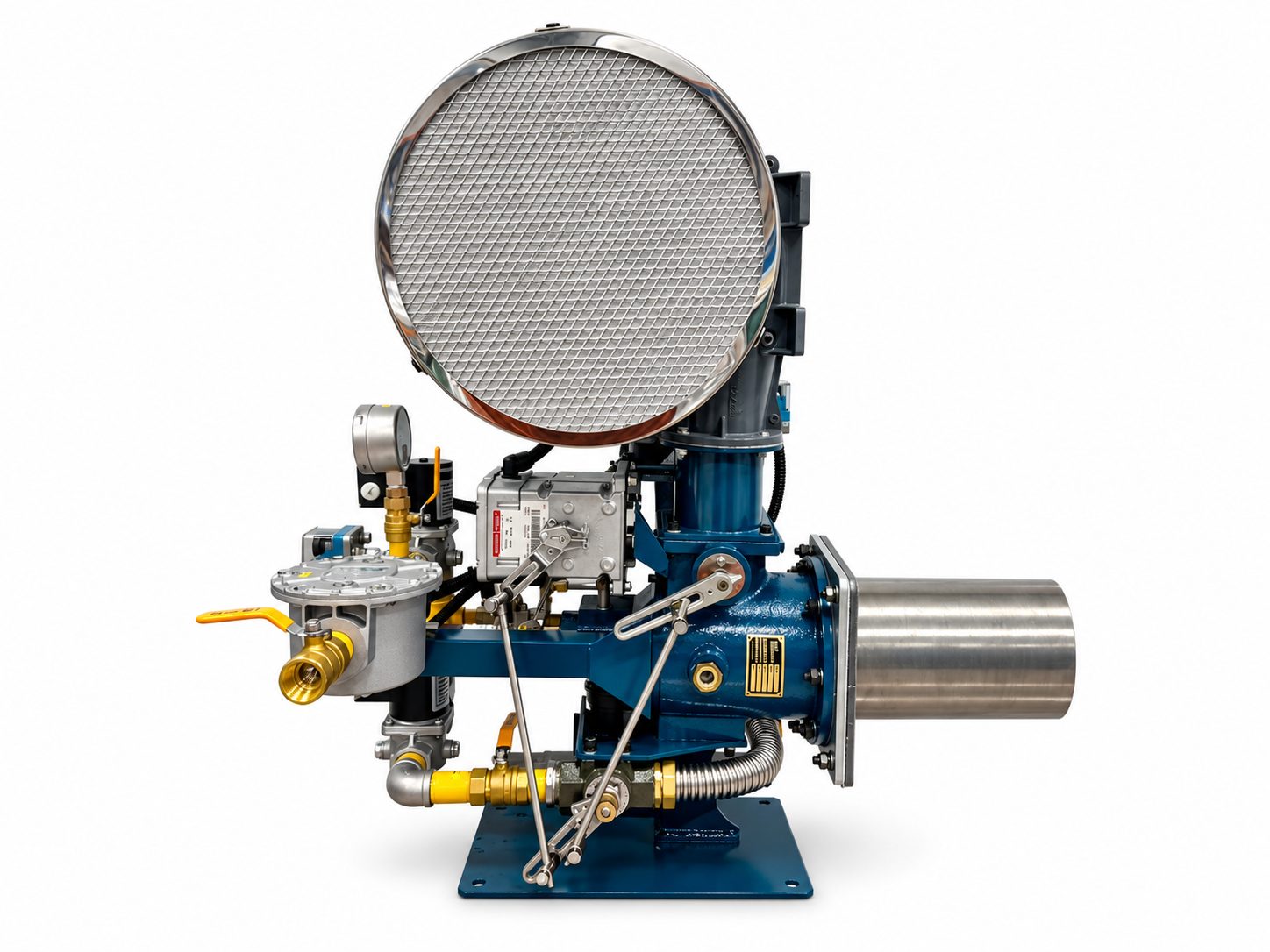
Most industrial gas users in Gauteng, Mpumalanga and KwaZulu-Natal take piped natural gas that comes from Mozambique through Sasol. Those fields are near the end of their life, and Sasol has announced that supply to industrial customers will stop; the date now expected is 2028. Short supply interruptions have already happened. Aluminium melters, steel reheating, ceramics, food and paper plants are asking the same question: if the gas stops, what keeps the furnace hot?
A dual-fuel burner is the cheapest answer for many of them. The furnace, the flame shape and the controls stay; the burner gains an oil gun and an oil train, and can run either fuel at full rating.
| Fuel | Typical handling | Points to watch |
|---|---|---|
| Diesel / gas oil | Unheated, pressure or air atomised | Easiest; good for start-up and standby |
| Waste-oil blends (used motor oil with diesel or paraffin) | Warmed in a day tank and ring main, filtered, air atomised | Water, sludge and metal particles: settling, water drain, fine duplex filters, wear-resistant nozzles |
| Heavy fuel oil | Heated tank to nozzle, trace-heated lines, recirculation | Must stay hot all the way; oil gun purged after every stop |
Oil only burns cleanly as a fine spray. There are three common ways to make it:
Blends that contain paraffin (kerosene) or diesel have low flash points, about 38 °C for paraffin and 55 °C for diesel. Heating such a blend to 80 to 100 °C in an open day tank releases flammable vapour. Heat it only as far as the burner needs for good atomising, which for many waste-oil blends is 50 to 60 °C; measure the viscosity rather than guess. Keep the day tank and ring main closed, vent the tank to a safe place, and choose electrical equipment for the hazardous area that results.
Holding and casting furnaces that tilt carry the burner with them. Gas and oil reach the burner through flexible metal hoses rated for the movement, the flame detector and cables are fixed so they cannot pull loose, and the furnace control sends a tilt signal so the burner goes to low fire or shuts down at the angle the process requires.
Where the burner body and mounting allow, a gas burner can be converted by adding an oil gun, an oil train and the interlocks. Where they do not, a new dual-fuel burner with the same mounting and flame length is usually quicker than modifying the old one. For Maxon and Eclipse burners we build replacements of the same size; see the model cross-reference.
We supply dual-fuel burners, gas trains and oil trains as assembled skids or as component sets for local assembly, with P&ID and assembly drawings. WhatsApp +86 135 2889 3050 or [email protected].
A nameplate photo, or your heat load, fuel and gas pressure. The reply comes from an engineer.
WhatsApp an engineer → [email protected]